


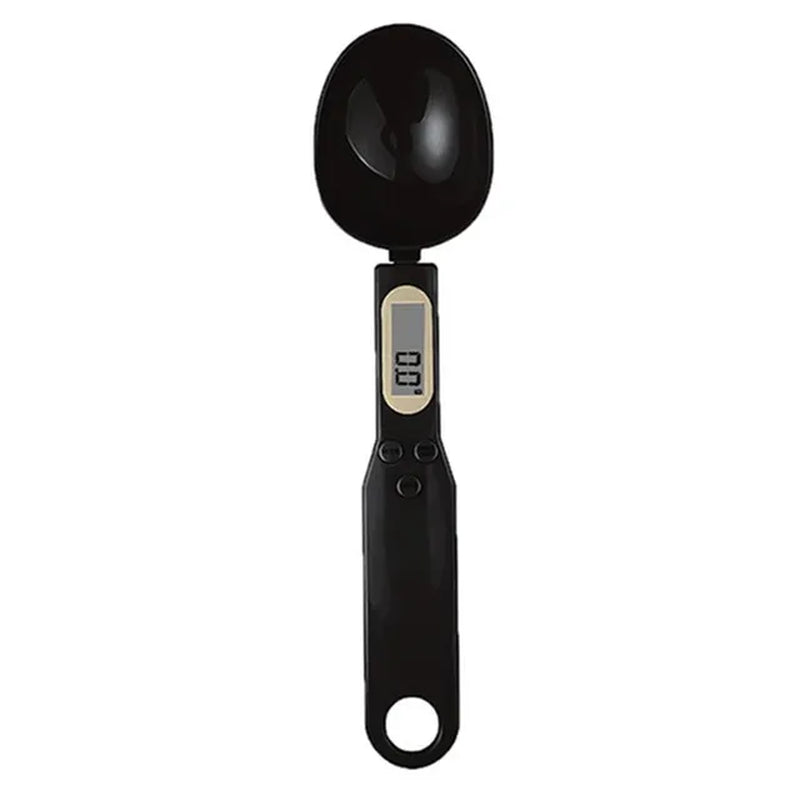

One scoop. One number.
The usual routine is three objects: a spoon, a bowl and a scale. Scoop, tip it out, read, adjust, wash the bowl.
This is one object. The load cell sits directly under the spoon head, so the number appears in the same motion you already make. Press TARE to zero out the spoon, scoop, read, pour. Nothing to transfer, nothing extra to wash.
A tablespoon measures space. Your recipe wants mass.
Density is the variable nobody measures.
A level tablespoon of cocoa and a level tablespoon of fine salt occupy identical volume and land at very different weights. A measuring spoon cannot tell the difference. A load cell can.
The Digital Spoon Scale puts that load cell directly under the bowl of the spoon. Capacity runs to 500 g, divisions are 0.1 g, and the display switches between grams and ounces with one press.
TARE zeroes out the spoon so the screen shows only what you add. HOLD freezes the reading before you tip — because you cannot read a display while you are pouring. Auto-off waits a full 2 minutes, so it does not shut down on you halfway through a recipe.
The head detaches for washing. The handle runs on a single CR2032 coin cell instead of a two-AAA pack, which is why it is slim enough to live inside the coffee jar rather than take up a drawer.
How to get a clean reading: hold the scale by the end of the handle, keep it horizontal, and let it settle for a few seconds without shaking. Tilting or gripping near the head is what produces the drifting numbers people complain about on cheap gram scales.
Same spoon. Same volume. Three different weights.
This is the whole problem with measuring by volume. One level tablespoon is a fixed amount of space, and density decides what fills it. Swap salt for flour and you have moved by more than half without changing a thing about how you scooped.
A recipe written in grams is not being fussy. It is removing this variable. So is this spoon.
100%
Table salt — about 18 g in one level tablespoon
44%
All-purpose flour — about 8 g in the very same spoon
31%
Cocoa powder — about 5.5 g, roughly a third of the salt
Approximate values for standard ingredients. Real densities shift with brand, humidity and how firmly you scoop — which is exactly why weighing beats measuring.
Spoon scale vs. measuring spoons
A measuring spoon measures space. Density decides what that space weighs. Here is the difference on paper.
| Welosi | Measuring spoons | |
|---|---|---|
Reads actual mass, not volume |
||
0.1 g divisions up to 500 g |
||
TARE to zero, HOLD to freeze the reading |
Where it earns its place
Have a Question ?
Is it accurate to 0.1 g?
0.1 g is the resolution — the smallest step the display shows. That is not the same as the tolerance. Like every compact gram scale in this class, expect a small margin either side of the true value, widening slightly at the top of the 500 g range. For baking, brewing, spices and supplement portions that margin is well inside what the task needs. For laboratory or trade use, it is not a certified instrument.
My reading drifts or looks wrong. What am I doing?
Almost always one of three things. Hold the scale by the end of the handle, not near the head — gripping close to the spoon loads the sensor. Keep it horizontal. And let it settle for a few seconds without shaking before you read. Press TARE with the spoon empty and level to re-zero at any point.
Which battery does it take? Is one included?
One CR2032 coin cell — the same type used in car keys, bathroom scales and kitchen timers. It is not included in the box. Check your drawer before you order, or add one to your cart with any grocery run. A single cell lasts a long time thanks to the 2-minute auto-off.
How do I clean it?
The spoon head detaches from the handle. Wash the head, then wipe the handle with a damp cloth. Do not submerge the handle or run it through a dishwasher — the sensor and display live inside it. Dry the contact point before clicking the head back on.